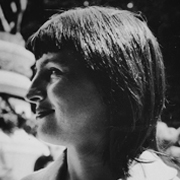
(1923-2008)
Maria Papa Rostkowska is an Italian-Polish sculptor known mainly for her marble works, some of which are monumental and visible in public spaces across Europe. After escaping the camps and the war, she left Poland to live and work between France and and Italy.
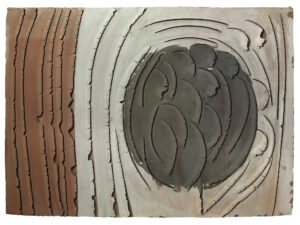
Untitled – 1959
Terracotta
48 x 66,5 cm / 18.9 x 26.1 in.

Guerrier – c. 1973
Travertine and shell marble
36 x 16 x 6 cm / 14.1 x 6.3 x 2.3 in.
Signed “M. PAPA” at the bottom on the sculpture
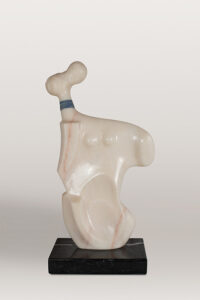
La femme au collier – c. 1975
Portuguese pink marble, lapis lazuli and Belgian black marble
50 x 30 x 5 cm / 19.6 x 11.8 x 2 in.
Signed “MPAPA” lower left on the sculpture
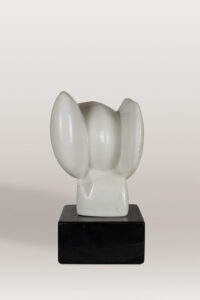
Ganesh – 1983
Carrara white marble and Belgian black marble
36 x 18 x 16 cm / 14.1 x 7 x 6.3 in.
Signed “MPAPA” at the bottom on the sculpture
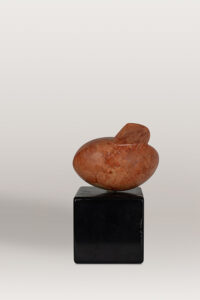
L’oiseau du bonheur – c. 1985
Red marble from Ferrara and Belgian black marble
25 x 18 x 14 cm / 9.8 x 7 x 5.5 in.
Signed “MPAPA” under the sculpture
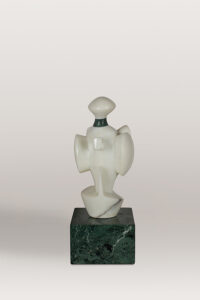
Guerrier au collier – c. 1987
Carrara white marble and green marble
31,5 x 11 x 11 cm / 12.4 x 4.3 x 4.3 in.
Signed “M. PAPA” at the bottom on the sculpture
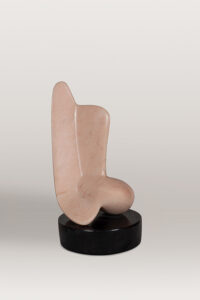
Ulysse – c. 1988
Portuguese pink marble and Belgian black marble
27 x 15 x 15 cm / 10.6 x 5.9 x 5.9 in.
Signed “M. PAPA” at the bottom on the sculpture
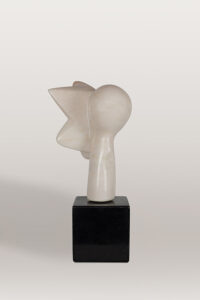
Petite fleur – c. 1990
Portuguese pink marble and Belgian black marble
40 x 18 x 11 cm / 15.7 x 7 x 4.3 in.
Signed “MPAPA” at the bottom on the sculpture
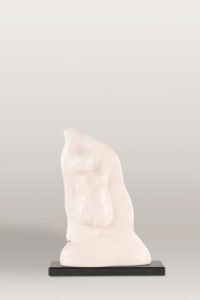
La Genèse – c. 1990
Portuguese pink marble and Belgian black marble
36 x 28,5 x 8 cm / 14.1 x 11.2 x 3.1 in.
Signed “MPAPA” lower right
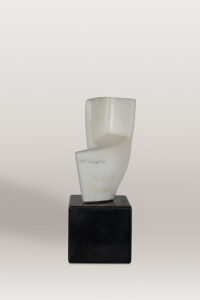
La maison de rêve – c. 1992
Carrara white marble and Belgian black marble
35 x 19 x 10 cm / 13.7 x 7.4 x 3.9 in.
Signed “MPAPA” at the bottom on the sculpture
Exhibitions
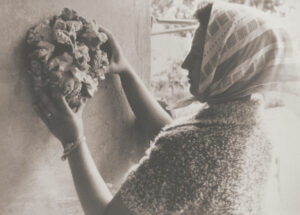
Publications
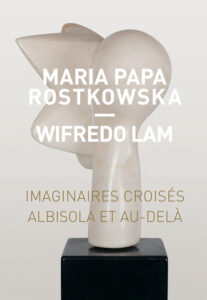
MARIA PAPA ROSTKOWSKA & WIFREDO LAM
Imaginaires croisés – Albisola et au-delà
Catalog 125 pages
Text by Nicolas Rostkowski
Videos
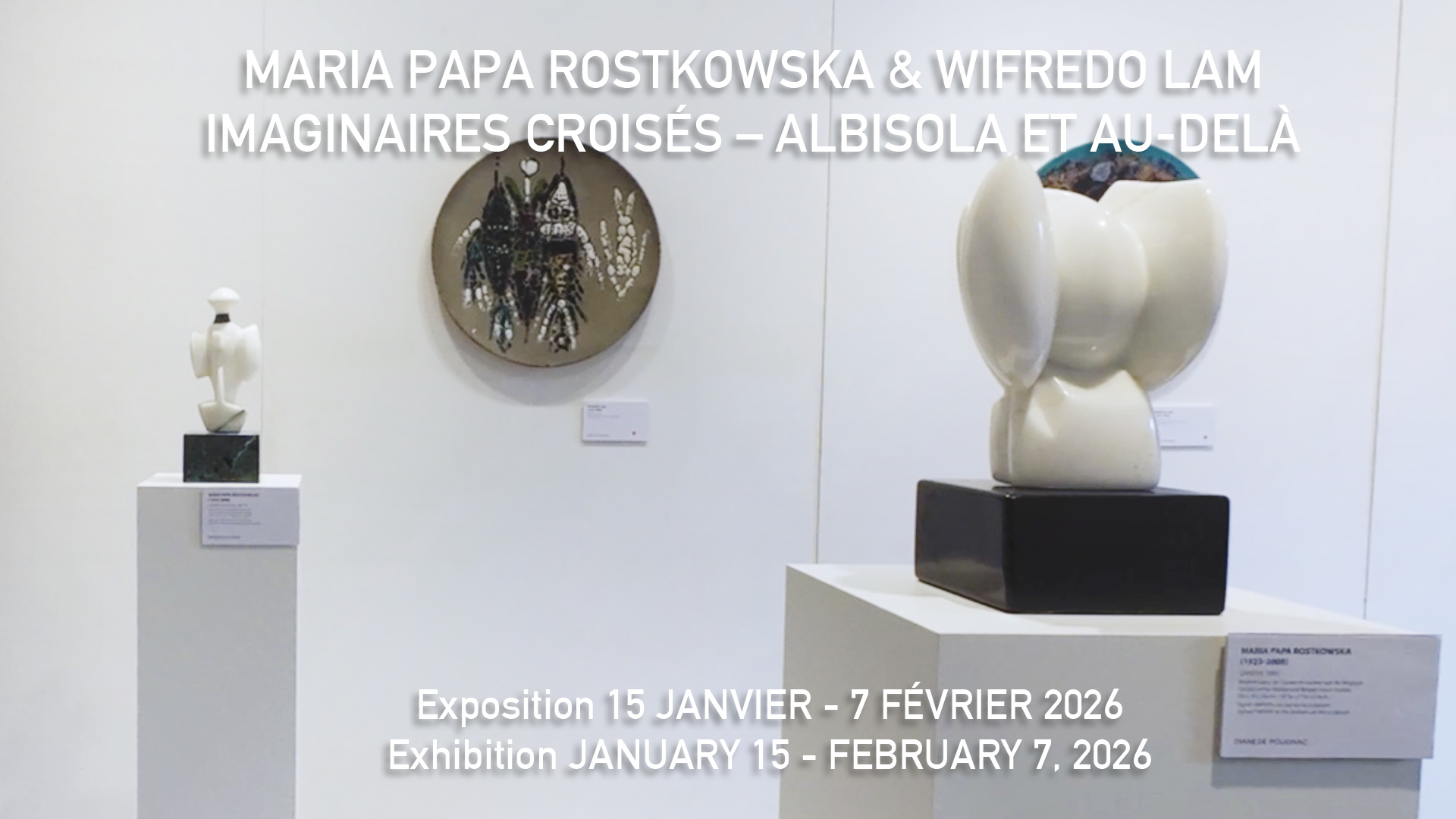
Visit of the exhibition “MARIA PAPA ROSTKOWSKA & WIFREDO LAM, Imaginaires croisés – Albisola et au-delà”.
From January 15 to February 7, 2026
Youth and resistance
Maria Papa Rostkowska (née Baranowska) was born on 4 July 1923 in Brwinów, in the suburbs of Warsaw, Poland. The youngest of four girls, she had just begun studying technical drawing and architecture at Jastrzebowski High School when the Second World War broke out.
In 1943, Maria Baranowska married Ludwik Rostkowski Jr., a Polish politician. Together, they joined the armed resistance and, with Ludwik’s father, Dr. Ludwik Rostkowski Sr. (a founding member of Zegota, an underground Polish resistance organisation to aid Jews), Maria Rostkowska helped rescue Jews from the Warsaw Ghetto. Ludwik Rostkowski Jr. was posthumously awarded the Righteous Among the Nations Medal.
After the outbreak of the Warsaw Uprising on 1 August 1944, Maria Rostkowska became an active member of the resistance and took part in the fighting against the Germans. She was arrested and put on a transport to Auschwitz. She was able to escape deportation, however, and returned to a devastated Warsaw. After liberation, she was awarded the Silver Cross of the Order of Virtuti Militari for her actions during the war. In 1945, she gave birth to her only son, Nicolas Rostkowski.
Recognition in Poland
In 1947, Maria Rostkowska resumed her studies and enrolled at the Academy of Fine Arts in Warsaw. After winning a scholarship from the Polish government, which was extended by UNESCO and the French government, she went to Paris, where she devoted herself to drawing and painting. Returning to Poland in 1950, she taught painting in Gdansk, and then in Warsaw. She regularly exhibited her works, which were in the socialist realist style. Most of these paintings are now kept at the Museum of Socialist Realism in Kozlówka.
Maria Rostkowska left Warsaw in 1950, in the wake of a wave of Stalinist repression that claimed the life of Ludwik Rostkowski Jr., a political activist and vice president of the Democratic Youth. She was accepted to the position of assistant at the State Higher School of Fine Arts in Sopot. Then, in 1953, Maria Papa was appointed Associate Professor at the Warsaw Academy of Fine Arts. Taking part in numerous exhibitions in Poland, the artist won a number of awards for her work. She was awarded the Polish State Art Prize for the large-scale mural decorations that she had created in 1954 in the old town of Lublin. The following year, in 1955, she received the prize once again for her painting La Silesienne.
Moving to Paris and sculpture
The Exhibition of Young Artists held at the Arsenal Gallery in Warsaw in 1955 was a major post-war event in Poland, marking the end of socialist realism in Polish art. It was there that Maria Rostkowska, who was exhibiting her self-portrait at the event, met the French painter Édouard Pignon. At the latter’s invitation, Maria Rostkowska moved to Paris in 1957. The French capital became her permanent home and the city she would hold most dear. A year later, she married Gualtieri Papa di San Lazzaro, a prominent Italian art critic, writer and journalist. He was also the founder of the art journal XXe Siècle and the eponymous gallery in Paris. They chose the writer Pierre Volboudt and the painter Serge Poliakoff to be the witnesses at their wedding.
In the summer of 1958, Maria Papa discovered the world of ceramics in Albisola, an Italian village renowned for its artistic community, which had gathered around the futurist ceramicist and poet Tullio Mazzotti. In Albisola, she worked with renowned artists such as Giuseppe Capogrossi, César, Roberto Crippa, Agenore Fabbri, Lucio Fontana, Asger Jorn, Wifredo Lam, Piero Manzoni and Milena Milani. Her creations, terracotta sculptures and bas-reliefs, were exhibited by the art dealer Carlo Cardazzo in his Galleria del Naviglio in Milan.
In Paris, Maria Papa Rostkowska produced several bronze castings and actively participated in numerous salons and exhibitions, exhibiting notably at the Salon de la Jeune Sculpture in 1961, 1962 and 1963. She forged friendships with a multitude of influential artists, including the painters Anna-Eva Bergman and Hans Hartung, Marc Chagall, Olivier Debré, Sonia Delaunay, Natalia Dumitresco and Alexandre Istrati, Maurice Estève, Robert Helman, Ladislas Kijno, Arika Madeyska, Alberto Magnelli, Joan Miró, Zoran Music, Édouard Pignon, Serge Poliakoff and Pierre Soulages. She was also associated with the sculptors Jean Arp, César, Émile Gilioli, Frans Krajcberg, Marino Marini, Henry Moore, Alicia Penalba, Ilio Signori and Alina Szapocznikow, as well as the writers Emil Cioran, Eugène Ionesco, André Pieyre de Mandargues, Adolf Rudnicki, André Verdet, and Cesare Zavattini, and the film director Vittorio de Sica.
In 1959, her son Nicolas joined her in Paris. Maria Papa Rostkowska then began to work back and forth between Albisola and Paris; in the latter, she used the studio of the sculptor Émile Gilioli
Choosing marble
In the mid-1960s, following the advice of Jean Arp, Gigi Guadagnucci and Marino Marini, Maria Papa began exploring the direct carving of marble, which became her preferred medium. In 1966, she was invited to participate in the Marble Symposium organised by the Henraux marble works in Querceta, Italy. She set up her studio there, near Pietrasanta, close to the Monte Altissimo and Carrara quarries. In the same year, she received an award from the William and Noma Copley Foundation for sculpture. This honour was also bestowed upon Alina Szapocznikow, making them the only two Polish artists to have been awarded the distinction. This marked the beginning of a prolific period during which Maria Papa created a wide range of marble and stone sculptures, from monumental works to more intimate pieces.
In 1968, her son Nicolas married Joëlle Ribert, who would go on to become an ethnologist with a passion for travel and comparative religion. Through their influence, Maria Papa travelled extensively, discovering the United States (1970), India (1979) and Iran (1973). In 1973, she travelled to Tehran at the invitation of Farah Diba, wife of the Shah of Iran, Mohammad Reza Pahlavi. She would later exhibit her work in Russia, at the Hermitage Museum. Gualtieri di San Lazzaro passed away in Paris on 8 September 1974. He was buried in the Montparnasse Cemetery, where Maria Papa laid a marble version of her Le Guerrier work on his grave.
After a thirty-four-year absence, Maria Papa presented her works in Poland in 1991, as part of a group exhibition of émigré artists at the Zacheta National Gallery of Art in Warsaw. In 1993, she recorded a series of interviews with a journalist, which were broadcast on Polish National Radio. In 1994, she returned to Poland for the first time since her departure in 1957; this would also be her final trip to her native country. The following year, a documentary film dedicated to her was broadcast on Polish national television. Entitled “Woman and Marble”, it showed her sculpting La Promesse de bonheur, a 3-metre-high work that now adorns the French National Assembly in the Palais Bourbon in Paris.
Throughout her life, Maria Papa Rostkowska took part in over one hundred solo and group exhibitions. Notable venues included Carlo and Renato Cardazzo’s Galleria del Naviglio in Milan, the Galleria del Cavallino in Venice and the Galerie XXe Siècle in Paris, as well as various Parisian salons. Her works have come to form a valuable part of numerous private and public collections in France, the United States, Switzerland, Belgium, Italy, Poland and Japan. Several of her sculptures and bas-reliefs can be found gracing European cities, including Paris and Warsaw.
During the 1990s, Maria Papa continued to create marble works that were true odes to life, joy and family. Although she suffered a stroke in 2001, she continued her work on small-scale marble pieces until she passed away in Lido di Camaiore, Italy, in 2008.
In June 2009, three of her monumental sculptures, Le Baiser, Le Lion and La Donna seduta, were donated to the Polish State by Nicolas Rostkowski. They now adorn the grounds of the National Museum of Poland in Warsaw.
In 2011, the monumental version of La Promesse de bonheur, which was a gift from Nicolas and Joëlle Rostkowski, was unveiled at the French National Assembly, inside the Palais Bourbon, opposite the entrance to the “hemicycle” chamber. The then President of the French Parliament, Bernard Accoyer, paid tribute to Maria Papa Rostkowska, describing her as “French at heart”.
Nicolas and Joëlle Rostkowski went on to donate more sculptures to Polish institutions: in 2014, the large sculpture Venus bionda was placed at the entrance to the Museum of Sculpture at the Królikarnia Palace. Two other sculptures, Le Guerrier and Mère et l’enfant, were installed in the Presidential Palace in Warsaw, in the orangery and reception room, respectively. Finally, the monumental sculpture La Fontaine de bonheur was installed at the Polish Library in Paris in 2015.
© Diane de Polignac Gallery / Mathilde Gubanski
Translation: Jane Mac Avock

SELECTED COLLECTIONS
Selected collections
France
Musée des Beaux-Arts, Dijon
Musée de Grenoble, Grenoble
Musée de l’Hospice Saint-Roch d’Issoudun, Issoudun
Musée de Menton, Menton
Musée d’Art et d’Histoire, Meudon
Musée Despiau-Wlérick, Mont de Marsan
Musée des Beaux-Arts, Nantes
Palais Bourbon Assemblée Nationale, Paris
Centre national des arts plastiques, Paris (en dépôt au Consulat Général de France, Houston, TX)
Musée de la sculpture en plein air, Paris
Bibliothèque Polonaise, Paris
Fondation de Coubertin, Saint-Rémy-lès-Chevreuse
Italy
Universita degli Studi, Milan
Banca Intesa, Milan
Parc international de la sculpture contemporaine, Pietrasanta
Fondazione Henraux, Querceta
Poland
Château Royal de Wawel, Cracovie
Musée National, Lublin
Centre de la Sculpture Contemporaine, Oronsko
Hôtel de ville de Sopot, Sopot
Palais Présidentiel, Varsovie
Musée National, Varsovie
Palais Royal de Lazienki, Varsovie
SELECTED EXHIBITIONS
Selected exhibitions
Exposition collective, Les Arts visuels en défense de la paix, Galerie nationale d’art Zacheta, Varsovie, Pologne, 1950
Exposition collective, 4e Festival d’art de Sopot : les arts visuels en défense de la paix, Galerie nationale d’art Zacheta, Varsovie, Pologne, 1951
Exposition collective, 2e Exposition nationale d’arts visuels. Peinture, sculpture, architecture, Galerie nationale d’art Zacheta, Varsovie, Pologne, 1951
Exposition collective, Exposition pour la célébration du 10e anniversaire du Parti des Travailleurs Polonais, Galerie nationale d’art Zacheta, Varsovie, Pologne, 1952
Exposition collective, 3e Exposition nationale d’arts visuels, Galerie nationale d’art Zacheta, Varsovie, Pologne, 1952
Exposition collective, Exposition de la Section de Varsovie de l’association des artistes et designers polonais, Galerie nationale d’art Zacheta, Varsovie, Pologne, 1953
Exposition collective, 4e Exposition nationale d’arts visuels, Galerie nationale d’art Zacheta, Varsovie, Pologne, 1954
Exposition collective, 5e Exposition de la section peinture, sculpture, graphisme de Varsovie, Galerie nationale d’art Zacheta, Varsovie, Pologne, 1954
Exposition nationale des jeunes artistes-plasticiens, Contre la guerre – contre le fascisme, l’Arsenal, Varsovie, Pologne, 1955
Exposition collective, 6e Exposition de la section peinture, sculpture, graphisme de Varsovie, Galerie Zacheta, Varsovie, Pologne, 1955
Exposition collective, Junge Generation. Polnische Kunstausstellung: Malerei, Bildhauerei, Plastik, Berlin, Allemagne, 1956
Exposition personnelle, Bas-reliefs en terre cuite, Albisola, Italie, 1959
Exposition personnelle, La Donna nell’arte contemporeanea, Galleria del Naviglio, Milan, Italie, 1959
11e Salon de la jeune sculpture, Jardin du Musée Rodin, Paris, France, 1959
Exposition personnelle, Formes et reliefs, Galerie XXe Siècle, Paris, France, 1960
12e Salon de la jeune sculpture, Jardin du Musée Rodin, Paris, France, 1960
13e Salon de la jeune sculpture, Jardin du Musée Rodin, Paris, France, 1961
Salon Comparaisons, Musée d’art moderne de la ville de Paris, Paris, France, 1961
Exposition personnelle, Galleria da Pescetto, Albisola, Italie, 1961
Exposition personnelle, Galleria del Naviglio, Milan, Italie, 1961
Salon Comparaisons, Musée d’art moderne de la ville de Paris, Paris, France, 1961
Exposition personnelle, Formes et reliefs II, Galerie XXe Siècle, Paris, France, 1962
Exposition collective, Collettiva femminile di pittura e scultura : Dadamaino, Maria Papa Rostkowska, Galleria da Galleria da Pescetto, Albisola, Italie, 1962
Exposition personnelle, Galleria da Pescetto, Albisola, Italie, 1962
Galleria della Palma Punto 3, Albisola, Italie, 1962
Exposition collective, Peintures, sculptures, dessins, Vallauris, Galerie Cavalero, Cannes, France, 1962
Salon Comparaisons, Musée d’art moderne de la ville de Paris, Paris, France, 1962
Punta San Martino di Arenzano – Galleria del Sole al Portichetto, troisième édition de « Arte rivolta alle stelle » avec la participation de Crippa, Capogrossi, Fontana, Fabbri, Maria Papa Rostkowska, Dadamaino, 1962
Exposition collective, Krit-Punto 2, Palacio de la Virreina, Barcelone, Espagne, 1962
Salon Comparaisons, Musée d’art moderne de la ville de Paris, Paris, France, 1963
Salon de Mai, Musée d’art moderne de la ville de Paris, Paris, France, 1963
Salon de la jeune sculpture, Jardin du Musée Rodin, Paris, France, 1963
Exposition personnelle, Sculpture champêtre, Centre Américain, Paris, France, 1963
Exposition collective, Albisola 63, Galleria da Pescetto, Albisola, Italie, 1963
18e Salon des Réalités nouvelles, Musée d’art moderne de la ville de Paris, Paris, France 1963
V Concorso Internazionale del Bronzetto, Sala della Ragione, Padoue, Italie, 1963
Exposition collective, Terza edizione Arte rivolta alle stelle, participants de l’exposition : Crippa, Capogrossi, Fontana, Fabbri, Maria Papa Rostkowska, Dadamaino, Galleria del Sole al Portichetto, Punta San Martino di Arenzano, Italie, 1963
Salon de Mai, Musée d’art moderne de la ville de Paris, Paris, France, 1964
Exposition collective, Le fantastique dans l’Art, Galerie Creuzevault, Paris, France, 1964
Exposition collective, Albisola, Galleria da Pescetto, Albisola, Italie, 1964
Salon des Réalités nouvelles, Musée d’art moderne de la ville de Paris, Paris, France, 1964
Salon de Mai, Musée d’art moderne de la ville de Paris, Paris, France, 1965
Exposition collective, Peintures, sculptures, objets, Galerie Creuzevault, Paris, France, 1965
Salon des Réalités nouvelles, Musée d’art moderne de la ville de Paris, Paris, France, 1965
Exposition collective, La Main, Galerie Claude Bernard, Paris, France, 1965
Exposition collective, Sous le signe de Pausias, Galerie XXe Siècle, Paris, France, 1965
Exposition collective, Donner à voir, Galleria da Pescetto, Albisola, Italie, 1965
Prix Nelson William Copley pour la sculpture, Salon de Mai, Musée d’art moderne de la ville de Paris, Paris, France, 1966
Salon International des galeries pilotes, Musée cantonal des Beaux-Arts, Lausanne, Suisse, 1966
Exposition collective, Exposition Internationale du Marbre, Museo Civico del Marmo, Carrare, Italie, 1966
Exposition collective, La petite sculpture, Galerie Maywald, Paris, France, 1966
Exposition collective, Galerie Moni Galatchi, Paris, France, 1966
Exposition collective, Symposium Du Marbre, Marbrerie Henraux, Querceta, Italie, 1966
Salon de Mai, Musée d’art moderne de la ville de Paris, Paris, France, 1966
Exposition personnelle, Galleria del Naviglio, Milan, Italie, 1967
Salon de Mai, Musée d’art moderne de la ville de Paris, Paris, France, 1967
Salon des Réalités nouvelles, Musée d’art moderne de la ville de Paris, Paris, France, 1967
Exposition collective, Le portrait, Galerie Claude Bernard, Paris, France, 1967
Ve Biennale Internationale de Sculpture, Carrare, Italie, 1967
Salon de Mai, Musée d’art moderne de la ville de Paris, Paris, France, 1968
Exposition collective, Galleria del Naviglio, Milan, Italie, 1968
Exposition collective, Galleria del Cavallino, Venise, Italie, 1968
Exposition personnelle, Galleria del Cavallino, Venise, Italie, 1968
VIe Biennale Internationale de Sculpture, Carrare, Italie, 1968
Salon de Mai, Musée d’art moderne de la ville de Paris, Paris, France, 1969
Peintres et sculpteurs italiens à Paris, Festival International des Arts, Menton, France, 1969
VIe Biennale Internationale de Sculpture, Carrare, Italie, 1969
Salon de Mai, Musée d’art moderne de la ville de Paris, Paris, France, 1970
Peintres et sculpteurs italiens à Paris, Festival International des Arts, Menton, France, 1970
Salon de Mai, Musée d’art moderne de la ville de Paris, Paris, France, 1971
Exposition personnelle, Galleria del Naviglio, Milan, Italie, 1972
Exposition personnelle, Galerie XXe Siècle, Paris, France, 1972
Salon de Mai, Musée d’art moderne de la ville de Paris, Paris, France, 1972
Exposition personnelle, Marbres 1969-1972, Galerie Mony Calatchi, Paris, France, 1972
Salon de Mai, Musée d’art moderne de la ville de Paris, Paris, France, 1973
VIIe Biennale Internationale de Sculpture, Carrare, Italie, 1973
Galleria Civica d’Arte Moderna, Ferrare, Italie, 1973
Mostra Raccolta di Sculture della Società Henraux, Marbrerie Henraux, Querceta, Italie, 1973
Salon de Mai, Musée d’art moderne de la ville de Paris, Paris, France, 1974
Xe Biennale Internationale d’Art, Menton, France, 1974
VIII Mostra Collettiva di Città di Massa, Massa, Italie, 1974
Exposition collective, Les sculpteurs italiens à Paris, Institut Culturel Italien, Paris, France, 1974
Exposition collective, Prima Collettiva della Scultura in Versilia, Querceta, Italie, 1974
Salon de Mai, Musée d’art moderne de la ville de Paris, Paris, France, 1975
Chevaux Sculptés, Château de Fontaine-Henry, France, 1975
L’arte nella riviera di Ponente, Mostra AICS (Associazione Italiana Culturale Sport), Savona, Italie, 1976
Salon de Mai, Musée d’art moderne de la ville de Paris, Paris, France, 1976
Grand Prix International d’Art Contemporain, Centre de Congrès Auditorium de Monte-Carlo, Monte Carlo, Monaco, 1976
XVI Mostra della Ceramicha, Castellmonte, Italie, 1976
XIIe Biennale Internationale d’Art, Menton, France, 1976
Rassegna, Mostra Internazionale della Ceramica, Albisola, Italie, 1976
Salon de Mai, Musée d’art moderne de la ville de Paris, Paris, France, 1977
Exposition personnelle, Exposition Féminine, Galleria Regis, Finale Ligure, Italie, 19
Première exposition collective de céramique, Estate 1977, Albisola, Italie, 1977
Salon de Mai, Musée d’art moderne de la ville de Paris, Paris, France, 1978
Première Triennale européenne de la Sculpture, Jardin du Palais-Royal, Paris, France, 1978
Mostra Estiva delle Sculture, Seravezza, Italie, 1978
Salon de Mai, Musée d’art moderne de la ville de Paris, Paris, France, 1979
Institut Culturel Italien, Paris, France, 1979
IV Biennale Internazionale Dantesca a Ravenna, Centro Dantesco Dei Frati Minori Conventuali Ravenne, Italie, 1979
Salon de Mai, Musée d’art moderne de la ville de Paris, Paris, France, 1980
Exposition collective, Exposition au profit de la Ligue contre le Cancer, Espace Cardin, Paris, France, 1980
Salon de Mai, Musée d’art moderne de la ville de Paris, Paris, France, 1981
II Trienale de la sculpture, Grand Palais, Paris, France, 1981
Premio di ceramica Bianco, Albissola Mare, Italie, 1981
Salon de Mai, Musée d’art moderne de la ville de Paris, Paris, France, 1982
Salon de Mai, Musée d’art moderne de la ville de Paris, Paris, France, 1983
Salon de Mai, Musée d’art moderne de la ville de Paris, Paris, France, 1984
Exposition collective de sculptures, La Donna Creativa, Centre culturel L. Russo, Couvent de Saint-Augustin, Pietrasanta, Italie, 1984
Exposition personnelle, Couvent Saint-Augustin, Loano, Italie, 1984
Salon d’Automne, Grand Palais, Paris, France, 1984
Salon de Mai, Musée d’art moderne de la ville de Paris, Paris, France, 1985
Exposition personnelle, Galleria del Naviglio, Milan, Italie, 1985
IIIe Triennale Européenne de sculpture, Musée Bourdelle, Paris, France, 1985
Sculture di Passagi, Villa Giorgini Schiff, Montignoso, Italie, 1985
Salon de Mai, Musée d’art moderne de la ville de Paris, Paris, France, 1986
Exposition personnelle, Galleria Farsetti, Cortina d’Ampezzo, Italie, 1986
Salon de Mai, Musée d’art moderne de la ville de Paris, Paris, France, 1987
Salon de Mai, Musée d’art moderne de la ville de Paris, Paris, France, 1988
Exposition collective, Les dessins des sculpteurs, Couvent de Saint-Augustin, Pietrasanta, Italie, 1988
Salon de Mai, Musée d’art moderne de la ville de Paris, Paris, France, 1989
Exposition collective, Les choix d’un amateur (Maria Papa, Anita da Caro et Roger Vieillard), Centre des Arts et loisirs du Vésinet, Vésinet, France, 1989
Salon de Mai, Musée d’art moderne de la ville de Paris, Paris, France, 1990
Exposition personnelle, Scultura ad Femminile, Studio d’Arte La Subbia, Lido di Camaiore, Italie, 1990
Salon de Mai, Musée d’art moderne de la ville de Paris, Paris, France, 1991
Triennale internationale de sculpture, Fondation de la culture, Osaka, Japon, 1991
Exposition personnelle, Galleria Subbia, Lido di Camaiore, Italie, 1991
Exposition collective, Nous sommes présents, Musée National Zacheta, Varsovie, Pologne, 1991
Exposition personnelle, Galerie Françoise Moulin, Lyon, France, 1991
Salon de Mai, Musée d’art moderne de la ville de Paris, Paris, France, 1992
Exposition collective, Galleria Poleschi, Forte dei Marmi, Italie, 1992
Triennale internationale de sculpture, Fondation de la culture, Osaka, Japon, 1993
Exposition collective, Galerie Poleschi, Forte dei Marmi, Italie, 1993
Exposition collective, Galleria Subbia, Lido de Camaiore, Italie, 1993
Exposition collective, Galerie Françoise Moulin, Lyon, France, 1993
Exposition collective, Galerie Yves Lebouc, Paris, France, 1993
Exposition collective, Galerie Bourdon, Paris, France, 1993
Exposition personnelle, Promesse de Bonheur, Galerie Point JAL, Paris, France, 1994
Exposition personnelle, Arika Madeyska, Painting. Maria Papa, Sculpture, Galerie Ars Polona, Varsovie, Pologne, 1994
Exposition collective, Galerie Art Public, Paris, France, 1994
Triennale Internationale de l’Art SACRUM, Czestochowa, Pologne, 1994
Exposition personnelle, Couvent de Saint-Augustin, Pietrasanta, Italie, 1995
Exposition collective, Sacrum, Lourdes, France, 1995
Triennale internationale de sculpture, Fondation de la culture, Osaka, Japon, 1995
Exposition collective, Yeux ouverts, Couvent de Saint-Augustin, Pietrasanta, Italie, 1995
Exposition collective, Situazioni sculture, Palazzo ducale, Lucca, Italie, 1996
Exposition collective, Le sembianze del mito sculture, San Giovanni in Persiceto, Italie, 1996
VIII Biennale Internazionale di Scultura, Carrare, Italie, 1996
Exposition collective, Forma felice, Museo Pianeta Azzurro, Centre International de Sculpture, Fregene Italie, 1996
Exposition collective, Centre culturel Ca la Ghironda, Ponte Ronca di Zola Predosa, Italie
Exposition collective, Galeria Contraste, Forte des Marmi, Italie, 1996
Exposition internationale collective, Piazza del Duomo, Pietrasanta, Italie, 1997
Exposition internationale de la sculpture, Artisti ed artigiani a Pietrasanta, Istituto Statale d’Arte Staggio Staggi, Pontestrada, Italie, 1997
Exposition collective, Centre Culturale Luigi Rosso, Pietrasanta, Italie, 1997
Exposition collective, Living language of Sculpture, Musée de l’Ermitage Saint-Pétersbourg, Russie, 1998
Exposition personnelle, Caresses du temps, Galerie Orenda, Paris, France, 2008
Exposition collective, Les talents venus de l’Est : ceux qui ont choisi l’Art à Paris, Galerie Orenda, Paris, France, 2009
Exposition collective, Les talents venus de l’Est : ceux qui ont choisi l’Art à Paris, Galerie Metro-Tamka, Varsovie, Pologne 2009
Exposition personnelle, Hommage à Maria Papa, Museo dei Bozzeti, Pietrasanta, Italie, 2009
Exposition collective, Michel-Ange et ses descendants, Montgomery Museum of Fine Arts, Montgomery, AL, États-Unis, 2009
Exposition personnelle, Spazio Tadini Casa Museo, Milan, Italie, 2009
Exposition personnelle, Maria Papa Rostkowska : Sculpture. Edith-Laure Rostkowski : Bijouterie artistique, Galeria Napiorkowska, Varsovie, Pologne, 2010
Exposition collective, Signe et Matière, (avec Caroline de Boissieu et Paolo Valle), Galerie Orenda, Paris, France, 2010
Rétrospective de l’oeuvre de Maria Papa, Galleria Stefano Cortina, Milan, Italie, 2012
Rétrospective des marbres de Maria Papa, Stefano Cortina Gallery, Milan, Italie, 2012
Exposition collective, Donne e Arte. Omaggio a Maria Papa, Couvent Saint-Augustin, Pietrasanta, Italie, 2012
Exposition rétrospective, Woman of marble, Musée National de Pologne, Palais de Krolikarnia, Varsovie, Pologne, 2014
Exposition collective, Michelangelo e la Versilia, Istituto Culturale Italiano di New York, New York, NY, 2015
Exposition collective, Pureté de la ligne (Maria Papa et Dadamaino), Galerie Orenda, Paris, France, 2015
Exposition personnelle, Femme de marbre, Bibliothèque Polonaise, Paris, France, 2015
Exposition collective, Jubilée, Musée national de Pologne, Varsovie, Pologne, 2016
Exposition personnelle, Maria Papa Rostkowska et ses amis, Musée d’Art Contemporain Cascina Roma, San Donato Milanese, Italie, 2017
Exposition collective, Jean Arp et la Pologne, Musée national de Poznan, Poznan, Pologne, 2017
Exposition personnelle, Maria Papa Rostkowska, Associazione Culturale Renzo Cortina, Milan, Italie, 2017
Exposition collective, Serge Poliakoff et ses amis, Galerie Pixi, Paris, France, 2018
Exposition rétrospective, Maria Papa Rostkowska et ses amis de l’École de Paris. Hommage à la Revue XXe Siècle, (Poliakoff, Esteve, Pignon, Miro, Chagall, Fontana, Magnelli…), Musée de l’Hospice Saint-Roch, Issoudun, 2020
Exposition personnelle, Maria Papa Rostkowska et ses affinités artistiques – Jean Arp, Émile Gilioli et Marino Marini, Musée d’Art et d’Histoire de Meudon, Meudon, France, 2022
Exposition personnelle, Maria Papa Rostkowska, la résonnance haptique de la matière, Centre de la sculpture polonaise, Oronsko, Pologne, 2023
Exposition personnelle, Promesse de bonheur, Musée du Palais royal, Varsovie, Pologne, 2023
Wifredo Lam et les magiciens de la mer, Musée de la Céramique, Savone, Italie, 2023
Exposition personnelle, La Sculptrice à rencontre du marbre, Fondation Coubertin, Saint-Rémy-lès-Chevreuse, France, 2024
Exposition personnelle, La force du destin, Musée de la ville de Pietrasanta, Italie, 2025
SELECTED BIBLIOGRAPHY
Selected bibliography
Luca Pietro Nicoletti, Maria Papa : Un destino europeo, monographie trilingue (italien, français, anglais), Milan, Cortina Arte et Paris, Orenda Art international, 2009
Bruno Botella, Petits secrets et grands privilèges de l’Assemblée nationale, Paris, Éditions du moment, 2013
Aleksandra Sobczak-Kövesi, Maria Papa Rostkowska – Woman of Marble, Varsovie, Musée national, 2014
Flaminio Gualdoni et Nicolas Rostkowski, Dadamaino, Maria Papa Rostkowska, Milan, Cortina Arte, 2015
Stefano Cortina, Joëlle Rostkowski et Agnieszka Tarasiuk, Maria Papa Rostkowska – La passion de la sculpture, Paris, Société Historique et Littéraire Polonaise de Paris, 2015
Marco Meneguzzo, Lydia Harambourg, Agnieszka Tarasiuk, Stefano Cortina, Massimo Mallegni, Maria Papa Rostkowska ; Le opere, gli amici, i luoghi. Milan, Cortina Arte, 2017
Lydia Harambourg, Patrice Moreau et Nicolas Rostkowski, Maria Papa Rostkowska – Une sculptrice au coeur de la Nouvelle École de Paris, Issoudun, Musée Saint Roch, 2020
Lydia Harambourg, Marianne Lombardi, Ewa Ziembinska, Agnieszka Tarasiuk et Nicolas Rostkowski, Jean Arp, Emile Gilioli, Marino Marini, Maria Papa Rostkowska et ses affinités artistiques, cat. exp., Musée d’art et d’histoire de Meudon, Cinisello Balsamo, Silvana Editoriale, 2022
Lara Conte, « Female sculptors at Henraux in the Sixties », Marmo, avril 2023
Maciej Aleksandrowicz, Marta Smolinska, Ursula Strobele, Burcu Dogramaci, Lydia Harambourg et un entretien avec Nicolas et Joelle Rostkowski, The haptic resonance of the matter: Maria Papa Rostkowska and female guests on the centenary of the Artist’s birth. Oronsko, Centrum Rzezby Polskiej, 2023
Sous la direction de Malgorzata Maria Grabczewska, textes de Marianna Otmianowska et Joelle Rostkowski, The Promise of Happiness – Maria Papa Rostkowska, Varsovie, Éditions Lazienki Krolewskie, 2023
Alexandra Merieux, Lydia Harambourg, Lara Conte et Nicolas Rostkowski, Maria Papa Rostkowska – Sculptrice à la rencontre du marbre, Saint-Rémy-lès-Chevreuse, Fondation de Coubertin, 2024
SELECTED SCULPTURES IN PUBLIC SPACES
Selected sculptures in public spaces
USA
Vénus noire qui marche, marbre noir, Consulat Général de France, Houston, Texas
France
Couple, composition monumentale en granit rose, Parc des Sculptures du Musée des Beaux-Arts – Palais de Carnolès, Menton, 1968
Guerrier du Désert, sculpture monumentale en marbre, cimetière du Montparnasse, tombe de Gualtieri Papa di San Lazzaro, Paris, 1974
La Mère et l’Enfant, ronde-bosse, commande de la ville de Paris, Direction des affaires scolaires, 3 rue de l’Arsenal, Paris, 1987
La Mère et l’Enfant, bas-relief monumental en travertin, commande de la ville de Paris, crèche municipale, 12 rue Duméril, Paris, 1989
Cactus qui marche, commande de la ville de Paris, Musée de la sculpture en plein air, jardin Tino-Rossi, port Saint-Bernard, Paris, 1997
La Promesse de bonheur, sculpture monumentale en marbre, don de Nicolas et Joëlle Rostkowski, Palais Bourbon, Assemblée nationale, Paris, 2011. Dévoilée par Bernard Accoyer, Président de l’Assemblée nationale. Cette « Française de coeur » est la première artiste étrangère à avoir une oeuvre présentée dans le Palais Bourbon. Cérémonie d’hommage pour le 100e anniversaire de l’artiste à l’Assemblée nationale par Yaël Braun-Pivet, Présidente de l’Assemblée nationale, 21 septembre 2023
La Fontaine du bonheur, sculpture monumentale en marbre, don de Nicolas et Joëlle Rostkowski, cour de la Société historique et littéraire polonaise, Bibliothèque Polonaise, Paris, 2015
Ubu Roi, sculpture monumentale en terre cuite et Grande Fleur, sculpture en marbre, dons de Nicolas et Joëlle Rostkowski, Parc de sculptures, Musée de l’Hospice Saint-Roch, Issoudun, 2020
La Mère et l’Enfant, sculpture en bronze et Bélier, terre cuite, don de Nicolas et Joëlle Rostkowski, Musée d’art et d’histoire, Meudon, 2022
Maternité, sculpture en bronze, don de Nicolas et Joëlle Rostkowski, place de la Chaume, Issoudun, 2022
La Découverte du Nouveau Monde, sculpture en bronze, don de Nicolas et Joëlle Rostkowski, Jardin des bronzes, Musée de la Fondation de Coubertin, Saint-Rémy-lès-Chevreuse, 2024
Sans titre, terre cuite, La pureté, sculpture en marbre et Torse féminin, sculpture en bronze, dons de Nicolas et Joëlle Rostkowski, parcours permanent de la Nouvelle École de Paris, Musée de Grenoble, 2025
Sans titre, relief en terre cuite, collection Gildas Fardel, Musée d’Art, Nantes
Vénus, marbre brun, Musée Despiau-Wlérick, Mont-de-Marsan
Il spirito del tempo, sculpture en marbre blanc de Carrare, Musée des Beaux-Arts, Dijon
Italy
Visage inconnu, La Tête et La Barque, dons de Nicolas et Joëlle Rostkowski, Musée Henraux, Querceta, 2009
La Rosa, don de Nicolas et Joëlle Rostkowski, Fondazione Centro Arti Visive, Pietrasanta, 2009
La Découverte du Nouveau Monde, sculpture monumentale en marbre, don de Nicolas et Joëlle Rostkowski, Universita degli Studi, Milan, 2010
Gaïa, don de Nicolas et Joëlle Rostkowski, place Gabriele d’Annunzio, Pietrasanta, 2014
Turan, bas-relief en marbre, don de Nicolas et Joëlle Rostkowski, collection permanente, Musée Henraux, Querceta, 2025
Poland
Le Baiser, La Donna Seduta et Le Lion, sculptures monumentales en marbre, dons de Nicolas et Joëlle Rostkowski, parc du Palais de Krolikarnia, Varsovie, 2010
Guerrier, sculpture monumentale en marbre, don de Nicolas et Joëlle Rostkowski, Orangerie du Palais présidentiel, Varsovie, 2015
Maternité, sculpture en bronze, don de Nicolas et Joëlle Rostkowski, salon Roccoco du Palais présidentiel, Varsovie, 2016
La Promesse de bonheur, sculpture en marbre blanc de Carrare, don de Nicolas et Joëlle Rostkowski, Palais royal du parc Lazienki, Varsovie, 2023
Cinq sculptures en terre cuite, dons de Nicolas et Joëlle Rostkowski, Musée national de Pologne, Varsovie, 2014
Venus Bionda, don de Nicolas et Joëlle Rostkowski, Parvis du Musée national de Pologne, Varsovie, 2014
Mère et l’Enfant, don de Nicolas et Joëlle Rostkowski, Parc de sculptures du Centre de la Sculpture Polonaise et Contemporaine, Oronsko, 2023
Mère et l’Enfant, don de Nicolas et Joëlle Rostkowski, Hôtel de Ville, Sopot, 2023
Guerrier, sculpture monumentale en marbre, don de Nicolas et Joëlle Rostkowski, château du Wawel, Cracovie, 2025
Le Guerrier du désert, bronze patiné noir, don de Nicolas et Joëlle Rostkowski, Musée national de Pologne, Lublin, 2025